
🎓 Anthropic’s AI Fluency Certification Review: The 4 Ds Every AI Product Manager Should Master | Nolan’s AI/Product Course Series (Vol 2)
Part 2 of my AI Certification Series: What Anthropic’s AI Fluency Framework taught me about AI Product Management, LLM Strategy, and Responsible AI. By Nolan F. Melson

Welcome to Volume 2 of My AI Certification Series.
As product managers building AI products, our job is no longer just to scope features or write PRDs. It is to collaborate with intelligence itself.
After completing Anthropic’s AI Fluency: Framework & Foundations certification, I walked away with more than theory. I left with a mental model, the 4 Ds, that fundamentally changed how I design, evaluate, and deploy AI-driven products.
Because if AI is going to reshape product management, the PMs who thrive will not just be technically literate. They will be AI fluent.
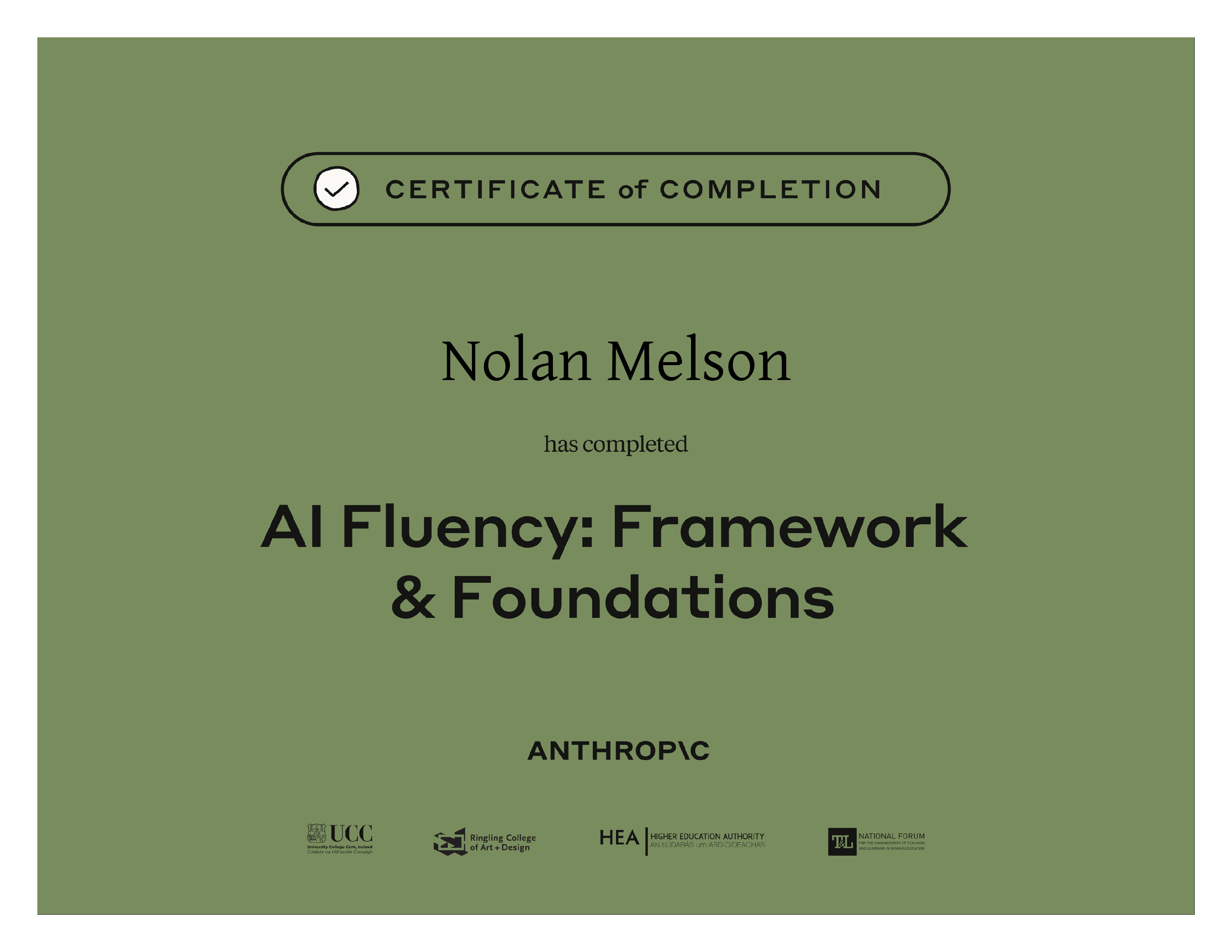
🧩 The 4 Ds, Through a PM’s Lens
Anthropic defines AI fluency through four competencies: Delegation, Description, Discernment, and Diligence.
Here’s how each one translates to the product world:
🪶 Delegation → Defining the human-AI boundary
Delegation is deciding which parts of a workflow to offload to AI and which to keep under human judgment. It is backlog triage at the algorithmic level, a balancing act between efficiency and responsibility.
In one course exercise, I mapped a multi-step project with Claude and had to choose what to delegate. The aha moment came when the model pushed back, asking if I was giving it too much.
That is when I realized that delegation to AI is not about automation, it is about leverage.
As Aakash Gupta, creator of Product Growth, put it:
“I stopped thinking of AI as ‘just automation.’ It doesn’t need to replace; it can extend.”
— Aakash Gupta, Product Growth
That single sentence captures the essence of smart Delegation for PMs: using AI not to replace capability but to amplify it.
💬 Description → Communicating intent precisely
Anthropic reframes prompting as a discipline of clarity. A good prompt is a good PRD: clear, contextual, and measurable.
The course outlines six prompting techniques (context, examples, constraints, step-by-step reasoning, asking the AI to “think first,” and defining its tone or role).
When applied to product management, those same techniques improve sprint briefs, user stories, and partner alignment. Whether talking to Claude or to an engineer, clarity equals velocity.
🧐 Discernment → Evaluating AI output with rigor
Every PM has seen confidently wrong data before; now it is just machine-generated.
Discernment means embedding quality control into every step: testing model outputs, comparing multiple responses, and understanding when the model’s reasoning goes off-track.
Anthropic calls this the Description–Discernment loop: describe, evaluate, refine. It is agile methodology for AI collaboration.
As Aakash Gupta notes in his article The AI Evaluation Revolution:
“The lack of systematic evaluation is the culprit behind building AI features that feel magical once but degrade over time.”
— Aakash Gupta, The AI Evaluation Revolution
That line captures the spirit of Discernment perfectly. Building durable AI products requires skepticism, structure, and a feedback loop that evolves as the model does.
⚖️ Diligence → Practicing transparency and ethics
What impressed me most about Anthropic was how they lived this principle. Their AI Diligence Statement discloses that Claude 3.7 helped draft course materials, under full human supervision.
That is the model we should follow as AI PMs: document when AI contributes, track model versions, and disclose collaboration when appropriate.
It is not compliance theater. It is earned trust.
🧠 Lessons That Scale
Lenny Rachitsky has argued that “prompting will quickly become table stakes” for PMs, but what will matter most is how we decide what to delegate and why.
“I don’t believe PMs will be displaced by GPT-4/5/6/n … prompt engineering will quickly become table stakes.”
— Lenny Rachitsky, Lenny’s Newsletter
Reid Hoffman echoes that sentiment in his writing on human-AI collaboration:
“AI is best understood as a tool that amplifies human agency. It allows us to extend what we can do, what we can understand, and how we collaborate.”
— Reid Hoffman, TechCrunch Interview
That alignment across thinkers—from Rachitsky to Gupta to Hoffman—reinforces Anthropic’s thesis: fluency is not about memorizing commands; it is about shaping intelligent collaboration.
🔑 Takeaways for AI-First Product Managers
✅ Fluency > Familiarity
Knowing what GPT or Claude can do is easy. Knowing when to use them responsibly is fluency. The 4 Ds scale across tools, making you adaptable even as models evolve.
✅ Design for Human + AI Workflows
Stop thinking “AI feature.” Start thinking “AI teammate.” Map how the model and the user iterate together, both in your product and in your process.
✅ Treat Prompts Like PRDs
Every prompt, system instruction, or model specification is effectively a mini product spec. Write it like you would hand it to an engineer.
✅ Build the Discernment Loop
Integrate evaluation directly into your product’s lifecycle. Continuous testing, multi-model comparisons, and human-in-the-loop checks should be standard, not optional.
✅ Make Diligence a Cultural Habit
Create templates for documenting AI collaboration: where models were used, what oversight existed, and how outputs were validated. Transparency builds stakeholder confidence.
✅ Lead With Responsibility, Not Fear
AI fluency is not about control. It is about coordination. The best PMs treat safety, privacy, and interpretability as features, not afterthoughts.
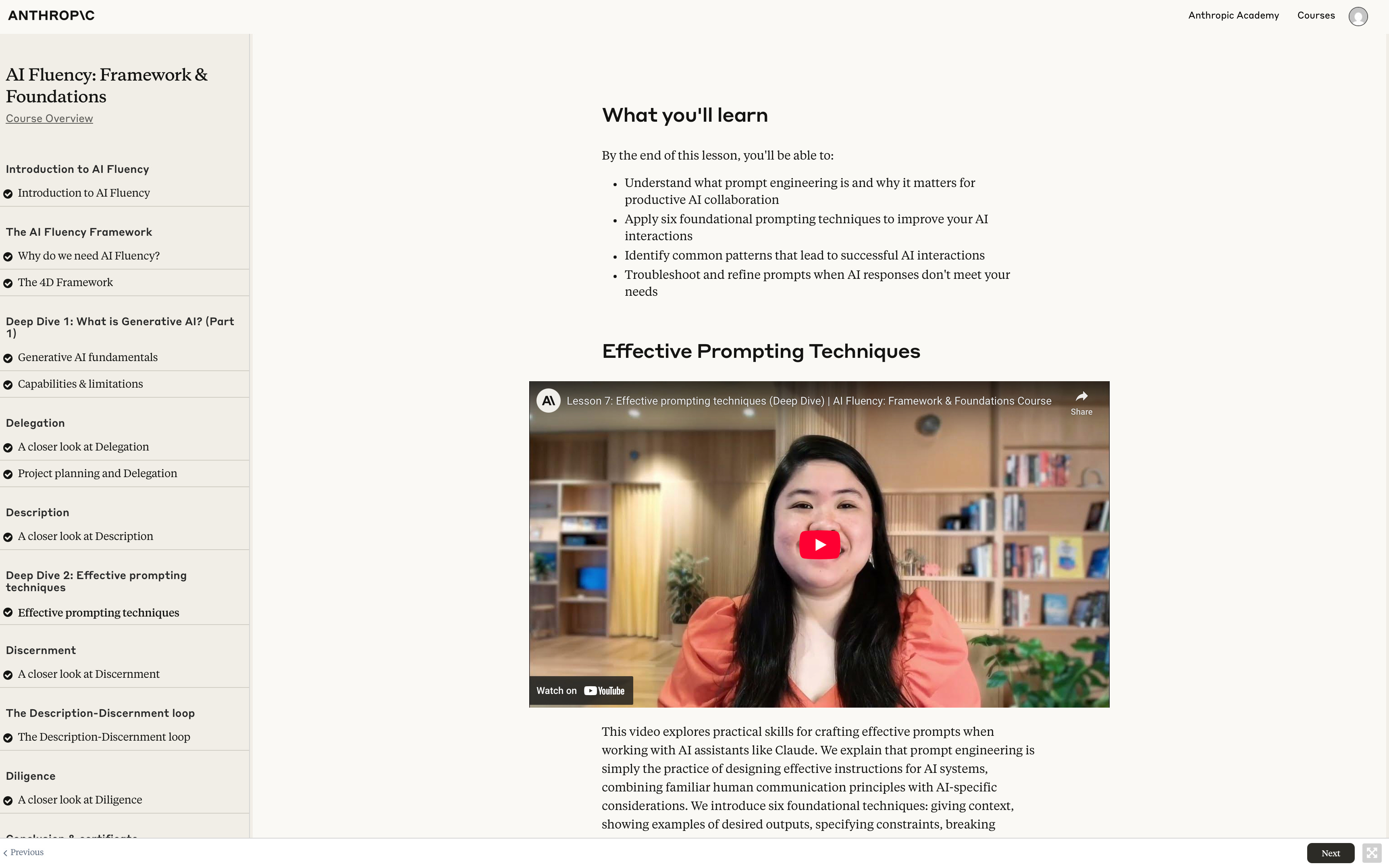
Anthropic closes its course with a simple reminder:
“AI systems are powerful but not magical.”
Neither are we. But when product managers combine human judgment with true AI fluency, we stop chasing features and start building responsibly intelligent products that scale with trust.
✍🏽 Thanks for reading! If you enjoyed this reflection, you can:
🔹 Subscribe: Nolan Melson’s Substack
🔹 Connect on LinkedIn: linkedin.com/in/nolanfmelson
🔹 Follow on X: x.com/NolanMelson
🔹 Bluesky: bsky.app/profile/nolanfmelson.bsky.social
Love the insights!
Solid breakdown of the 4D Framework from a PM lens. The point about delegation being "backlog triage at the algorithmic level" is a framing I haven't seen anyone else use and it clicks immediately.
Since you reviewed this, the catalogue has grown quite a bit. There are now 13 courses on Skilljar covering everything from the foundations you reviewed here through to building MCP servers and an Agent Skills course. I mapped the full thing recently https://reading.sh/anthropic-is-giving-away-13-free-ai-courses-with-certificates-94e2c08623e2 and the developer track in particular takes the Description and Discernment principles and makes them concrete with actual API workflows. Worth a revisit if you haven't checked back.